
How big is the building?
A single entrance, a whole elevation or several sides of a building need different camera setups. Start by deciding how much of the structure must be visible and then choose the camera to suit.
If the roost location is unknown, you may need to watch the full roofline, eaves and surrounding flight space to discover where bats appear. If the entrance is known or internal monitoring might be beneficial, a close view can show emergence, re-entry and bat behaviour in detail.
Size is only part of the question. A small building with several roof pitches can be harder to cover than a large, flat elevation. Chimneys, extensions, parapets and vegetation can hide possible entrances, so one wide view may still leave gaps.
Map the areas that need watching and choose camera positions that keep them visible. Where one camera cannot cover them, use several views with enough overlap to follow bats between them.
Where do bats roost in buildings?
Buildings of almost any age or construction can contain bat roosts where suitable spaces, temperatures and shelter are available. Modern houses, stone cottages, barns, churches, bridges and industrial buildings all offer possibilities, often hidden from view.
Different species use different features. The common pipistrelle (Pipistrellus pipistrellus) and soprano pipistrelle (Pipistrellus pygmaeus) squeeze beneath roof tiles, behind hanging tiles, soffits and bargeboards, and into cavity walls. They may never enter the main roof void, so an internal inspection can miss them entirely.
The brown long-eared bat (Plecotus auritus) is associated with larger roof voids in older buildings, barns and churches, roosting around the apex and timbers and using the open space for flight. Natterer’s bat (Myotis nattereri) may occupy mortise joints and gaps between beams, while horseshoe bats need openings through which they can fly directly inside.
The barbastelle (Barbastella barbastellus) is less commonly encountered in buildings but has been recorded behind timber joints, cladding and shutters, in crevices resembling its woodland roosts.
Several species may therefore use the same building in different ways. A survey needs to consider the whole structure rather than one obvious hole, which is why wide camera coverage is so often important.
Look across roof edges, ridges, eaves, flashing, masonry, cladding and junctions between materials. Mark potential access points before positioning cameras, including small crevices and areas obscured from the ground.
Should you choose infrared or thermal?
Seeing in the dark
There are two common options for revealing activity when it’s dark:
Infrared records reflected light
An infrared illuminator or torch supplies light after dark at wavelengths bats and humans can’t see. A near-infrared camera records the light reflected from the bat and building. Specialist night vision cameras are sensitive to the infrared wavelengths and don’t have an infrared blocking filter which is common on most cameras.
Infrared can show surface detail, behaviour and the precise gap from which a bat emerges. It can also cover a whole elevation if the illumination is sufficiently broad and even. Using a narrow infrared beam from a torch concentrates light at distance; a wide beam from an illuminator spreads it over more of the building. Dark surfaces, recesses and bright foreground objects can make exposure difficult.
For infrared the limitation is illumination. Illumination becomes progressively harder to deliver over distance, particularly if a wide area needs to be lit. As the light travels away from the illuminator, it spreads out over an increasingly large area. This means illumination falls very quickly with distance: by the time the light has travelled twice as far, it is spread over roughly four times the area. The light then has to reflect from the building or bat and travel back towards the sensor. For this reason, distant subjects become much harder to illuminate clearly without powerful illuminators.
Infrared illuminators can attract moths and other flying insects. Positioning them away from the camera helps prevent insects from dominating the footage.
Infrared cameras are good for close range species identification at high frame rates as the resolution of the video can resolve ear, wing and tail shapes.
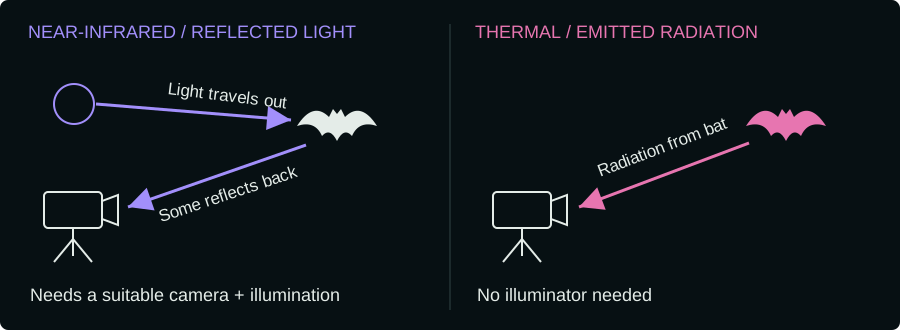
Thermal records emitted radiation
All objects give off long-wave infrared radiation, and hotter objects generally emit more. This radiation travels out from the object in all directions. Thermal imaging therefore does not need light to travel from an illuminator to the bat and back towards a camera; the bat and building emit the infrared radiation themselves and the camera detects this. This makes thermal cameras convenient for broad elevations and surrounding flight space.
An uncooled thermal camera uses a microbolometer: an array of tiny detector cells that absorb this long-wave infrared radiation. Each cell warms by a tiny amount, changing its electrical resistance. The camera measures these changes across the array to form the thermal image. Because of the detector technology it is only feasible to add a relatively small number of cells in the array compared to an infrared sensor, this means that the resolutions are generally lower: most commercially available thermal sensors detect 640 × 480 pixels, compared to 1920 × 1080 in infrared image sensors. Thermal contrast can make a bat conspicuous despite that lower resolution. Because of the lower resolution thermal imagery is less suited to recording bats at close range and identifying species.
Thermal sensors don’t require external illumination but at greater ranges the bat occupies fewer pixels and at a certain distance cannot be distinguished from the background. When recording with a 640 x 480p sensor recording at 60Hz, with a medium field of view (FOV), this is usually around 30 m against busy backgrounds and 125m against a cold sky. This distance will be reduced for cameras with a wider field of view.
Will the camera detect bats at your survey distance?
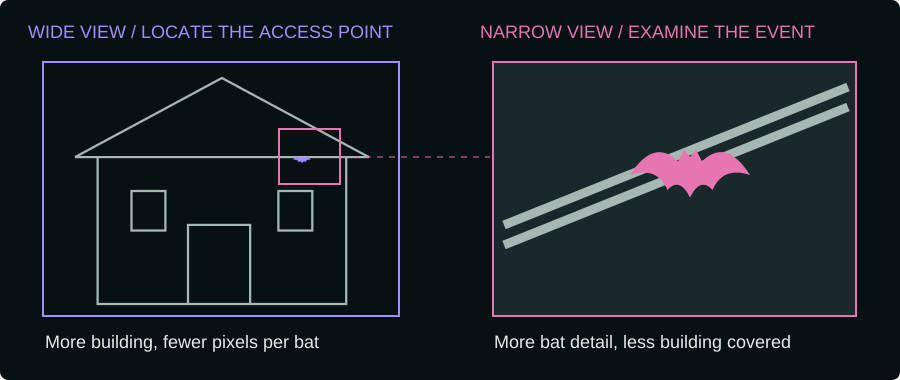
A camera can show a whole building without showing each bat clearly enough to answer the survey question. The farther away the camera is, or the wider its view, the fewer pixels each bat occupies.
For finding an unknown entrance, broad coverage is useful. For behaviour, counting or possible species identification, a closer view can provide more useful detail. Combine wide and close views where one camera cannot do both.
Infrared: match sensitivity and illumination to distance
Reflex Standard provides versatile infrared imaging for shorter survey distances <4 m, this is useful for internal roof voids and known roost entrances. Reflex Lynx has a large, ultra-sensitive infrared sensor for brighter imagery with less illumination, paired with an external illuminator is capable of surveying entire aspects of large buildings.
Check that the light reaches the whole area being monitored. A sensitive sensor helps but be cautious of uneven illumination and over and under exposure through the image. Get to know the capability of the camera and illumination by viewing the images after dark at the distance you intend to use them.
Thermal: check pixels and contrast
The wide-angle Reflex Thermal Pit Viper provides 640 × 480 thermal imaging across building elevations and the surrounding flight space without the need for an infrared floodlight. As distance increases, a bat occupies fewer pixels in the image, so the field of view and contrast against the background determine detectability.
If two identical thermal cameras are positioned the same distance from a building, the camera with the wider field of view will show the bat across fewer pixels. This means the bat will become harder to distinguish from the background. However, a wider-angle camera can often be positioned closer to the building, helping to recover some of that lost detail while still covering a large area. Using a camera in a range of different conditions and against a range of backgrounds will help establish the distances at which bats remain visible in the footage. After several surveys, you will develop a better understanding of the distances at which bats remain detectable under different levels of thermal contrast.
Sun-warmed roofs and walls can reduce contrast at dusk. Conditions are likely to improve as surfaces cool so a dusk-to-dawn survey can improve the survey results (with Reflex Cameras unmanned recording is possible).
Can it capture a fast emergence clearly?
Resolution describes the pixels in each frame. Frame rate describes how often a frame is recorded. Both matter, but neither compensates for poor focus, weak illumination, long exposure or a bat that is too small in the image.
Reflex Standard and Lynx record at 30, 60 or 120 fps. At 120 fps, more frames are available during a brief emergence or re-entry. This is particularly useful for species identification where the view and image quality reveal diagnostic features, and for examining behaviour frame by frame.
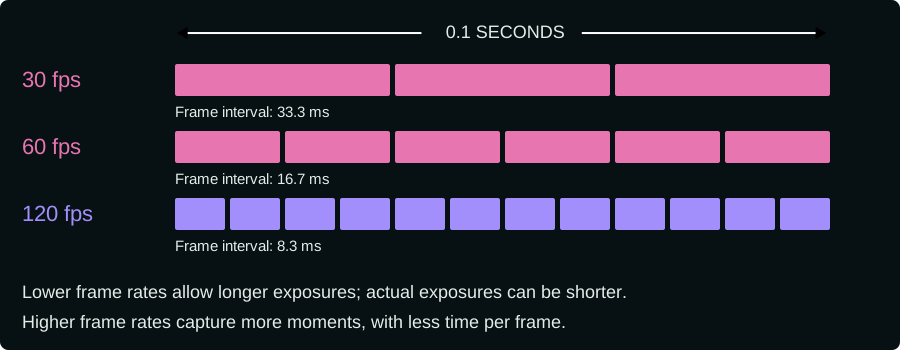
A short exposure reduces motion blur in infrared footage but requires more illumination as the sensor has less time to collect light. Increasing gain can brighten the image, although it also amplifies image noise. The Reflex Lynx’s large, highly sensitive infra-red sensor and specialist analogue gain allow it to produce brighter, cleaner footage in low light, with less noise at higher gain settings than would otherwise be expected. Adequate infrared illumination remains important, particularly as distance increases.
The Reflex Pit Viper provides 60 Hz thermal imaging. For thermal cameras, detector response also affects the clarity of fast movement; refresh rate alone does not describe the complete performance.
Choose recording settings that preserve useful detail
A resolution of 1920 × 1080 is practical for infrared surveys and can provide useful coverage of large building elevations. More pixels do not automatically make footage more informative. Thermal footage may be only 640 × 480 pixels but can still outperform higher-resolution infrared footage because bats often contrast strongly with the thermal background.
Similarly, 4K recording does not automatically improve a night survey and substantially increases storage and processing requirements. Consider higher resolutions where they add genuinely useful detail, but they are unnecessary for most surveys.
How easily can you find bats in the recordings?
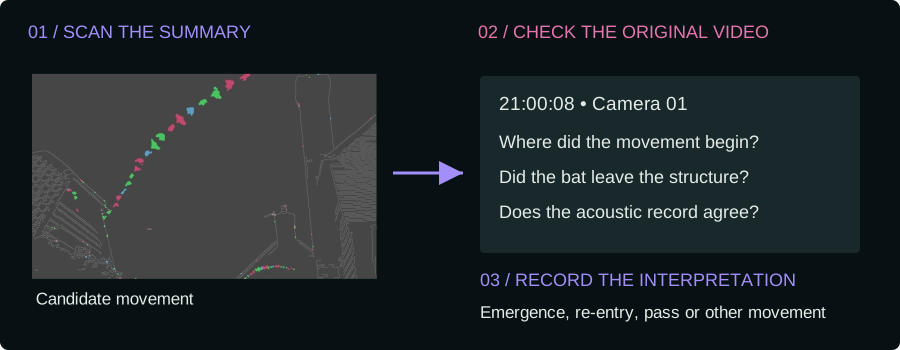
A bat crossing a roofline may have emerged from the building or simply flown past. Preserve enough context to follow the sequence: access point → bat → flight path. This also helps distinguish re-entry, repeated approaches and activity around more than one entrance.
Motion analysis makes brief events easier to locate among hours of footage. A visual summary overlays movement onto a simplified background to show where movement occurred in the video, allowing the reviewer to quickly screen recordings for likely bat activity before opening the original video.
Review during or after the survey
Decide whether to watch the footage live on the survey and pair cameras with surveyors or leave unmanned cameras (which are monitored by a roaming surveyor) and then review the footage later. Reviewing later adds the option of using motion analysis services (such as the Reflex Footage Motion Analysis service) which can substantially reduce analysis time and improve bat detections.
Reflex Cameras run advanced motion detection live while recording video. This detection can pick up small pixel changes that are easy to overlook while watching at full speed. The cameras can save videos on motion-triggers or record continuously. The cameras also produce timestamped summary images showing the movement that occurred in each 15 seconds of video to enable fast review. Finally live tracking can be viewed immediately during the survey over local WiFi.
What else will you need for the survey?
Compare the complete setup, including lighting, power, mounting, storage and the time needed to review recordings.
Illumination
Infrared cameras need enough light across the whole area being monitored. Match the illuminator’s beam angle to the view and check for glare, dark recesses and shadow beneath eaves. Add or reposition lights where necessary. Thermal cameras do not need an infrared illuminator.
Power, mounting and storage
Allow for the power used by both the camera and any external lights over the intended recording period. Use a secure mount, suitable weather protection and enough storage for the selected resolution, frame rate and recording mode. Confirm the schedule before leaving the camera.
A live view for setting up
If a surveyor is going to watch the footage live then they will need a suitably sized screen to see the required detail. Check how your camera outputs video. Reflex Cameras can stream video over Wi-Fi to a phone, tablet or computer.
Check framing, focus and live motion tracking while positioning the camera, then confirm the image under survey conditions. Infra-red cameras usually need refocusing after the sun has set, the Reflex Lynx maintains focus between daylight and infrared so can be left without this extra check.
As Reflex Cameras support advanced live motion detection, you can set where in the image you want to detect bats and exclude areas of no interest (moving branches, clouds etc).
Acoustic records and reliable timings
It is wise to synchronise camera and bat-detector clocks, including time zone and daylight-saving settings, so visual events can be compared with acoustic evidence later.
Videos from Reflex Cameras are timestamped so they can be dropped into a folder of wav files from acoustic recorders and immediately paired.
Infrared or thermal: a quick comparison
Choose against the survey question and the amount of building that must be covered.
| Consideration | Infrared | Thermal |
|---|---|---|
| Best for | Flexibility. Tighter views of entrances with detailed imagery that can support species identification, or wider views where suitable illumination can be provided. | Simple and effective wide coverage. Finding unknown access points and following bats around large or complex elevations without an illuminator. |
| Typical view | From a whole elevation to a tight view of selected features, depending on the lens and illumination. | Usually a broad view of the elevation and surrounding flight space. |
| Image detail | Higher visible detail when focus, illumination, distance and frame rate are well matched. | Clear detection of warm moving subjects, with less fine surface detail than infrared. |
| Illumination | Requires suitable infrared illumination across the complete area of interest. | No infrared illuminator required. |
| Main limitation | Wide coverage requires enough infrared power and even illumination; working distance and shadows must be managed. | A warm background can reduce contrast around dusk in hot weather, and thermal imagery provides less fine identification detail. |
| Warm weather | Image formation does not depend on temperature contrast, so a hot background does not create the same constraint. | As surfaces cool later into the evening better contrast should be achieved; check conditions at the required survey time. |
Which Reflex camera suits your survey?
Choose according to the area being monitored, working distance and detail required.
| Camera | When to choose it | What to allow for |
|---|---|---|
| Reflex Standard | Infrared imaging for surveys around roost entrances <4 m distances. Records at 30, 60 or 120 fps. | Suitable illumination across the view. Check that distance and framing retain enough detail. |
| Reflex Lynx | Close monitoring of roost entrances or surveys of entire building elevations (with external lighting). Records at 30, 60 or 120 fps. | Appropriate illumination for wide elevations or longer distances. A wider view still means fewer pixels per bat. |
| Reflex Thermal Pit Viper | Wide-angle, illumination-free coverage of entire elevations and flight spaces. 640 × 480 thermal imaging at 60 Hz. | Enough pixels on the bat and useful contrast against the background. Less fine surface detail than a well-lit infrared view. |
All three Reflex cameras provide advanced motion detection, live tracking and visual summaries to help find activity in the recordings.
For a whole elevation, consider the Reflex Thermal Pit Viper or an adequately illuminated Reflex Lynx. For a detailed view of a known entrance, consider Reflex Standard or Lynx. When the survey needs both broad coverage and fine detail, combine views.
Technical reading
BCT: Bat Emergence Surveys with Night Vision Aids — A Technical Guide FLIR: What You Need to Know About IR Detectors FLIR: High Speed Thermal Cameras — the Need for Speed